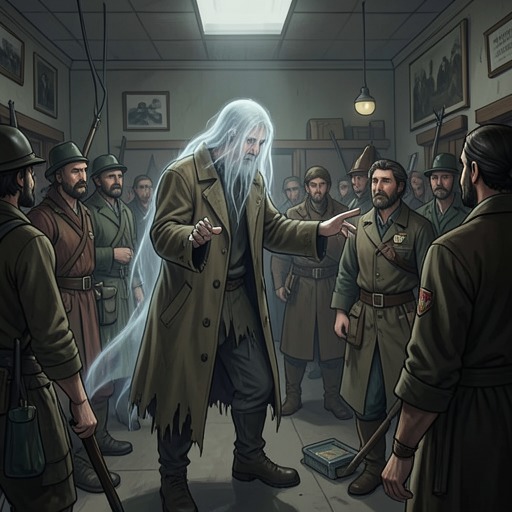
Oncle Julien's failed curse
Blood CanticleOncle Julien’s curse is the belief, reported by Tante Oscar, that his interventions in the lives of the living always fail. Its clearest example is his unsuccessful attempt to direct Merrick Mayfair’s future: although he urged Merrick’s dying great-grandmother to give the child to the Talamasca, Merrick eventually became one of the Blood Children. The curse gives Julien’s appearances a tragic pattern, and it becomes a measure against which Lestat tests his own hope that a being marked by evil might still do good.
The reported curse and its example
Rowan recounts Tante Oscar’s account of Julien’s intervention. He appeared in a dream to Merrick’s great-grandmother as she was dying and told her to give Merrick to the Talamasca. Tante Oscar understood this attempt as a characteristic failure: Julien’s interference in the world of the living, she said, was cursed always to come to nothing.
The warning did not avert the outcome Tante Oscar describes. Merrick grew up in the Talamasca, but later became one of the Blood Children, a change that Tante Oscar presents as having been foreseen by Merrick’s great-uncle Vervain. Julien’s appeal to place the child with the Order therefore sits within a larger story of foreknowledge, attempted intervention, and an outcome that proceeds despite it. The evidence presents the curse as Tante Oscar’s explanation of Julien’s failure, not as a separately demonstrated supernatural law.
Julien, the living, and the dead
The curse concerns Julien’s attempts to affect the living, but other characters distinguish those attempts from contact with the dead. Mona says Julien came to her long ago in dreams when he wanted her to do something, and that he is in the Light and does not return to Earth without an important reason. Her account places his appearances within a boundary between the dead and the living, even as Tante Oscar’s story makes his intervention across that boundary consequential and ineffective.
Lestat later invokes the curse while thinking about Julien’s presence around the living. He interprets Julien’s time on Earth as a possible payment for his sins and, in that sense, a waste. This is Lestat’s judgment rather than an independently confirmed explanation of Julien’s condition. It nevertheless links the curse to a moral question running through Lestat’s reflections: whether power exercised in the world can repair harm, or whether intention is defeated by the consequences it cannot control.
Lestat’s doubts about evil and good
The rule resonates with Lestat’s own sense of moral incapacity. He describes himself as ritually impure, living by the blood of others, and doubts that anything he does can produce anything but evil. His imagined wish to become a priest and consecrate the host collapses into recognition that he is a vampire, not the saint he had fantasized about becoming. The contrast gives the curse more than a plot function: it frames the fear that a compromised person’s effort to do good may be futile before it begins.
Lestat states the theological problem in deliberately stark terms, arguing that the harder question may be how good exists in a world where evil is already evident. That doubt is tested when he says he will find Ash and Morrigan, prompting Mona to demand what he means. His promise does not prove that he can reverse Julien’s failures, but it marks a choice to act despite uncertainty about his own goodness and the likely limits of his power.
A possible exception, not a settled answer
Patsy’s passage into the Light offers the clearest counterpoint to the curse. After Patsy’s death, Lestat tells her that Quinn will preserve and share her songs, then reaches toward her as she begins to rise. He kisses her, and describes a force moving through him and carrying her away. Mona calls to Patsy as she goes, while Quinn vows that he will give her songs lasting life. The scene presents Lestat’s intervention as effective in this particular moment, unlike the failures attributed to Julien.
The outcome remains bounded by uncertainty. Lestat later says he is not sure what happened: he and Patsy seemed connected as she rose, and some force may have tried to take him with her, but he managed to get away. Quinn says he saw the Light but not Patsy’s spirit; another witness confirms seeing the Light and recalls Lestat fighting with someone and invoking Julien. Patsy is gone, which Lestat identifies as the important fact, but the episode does not establish that Julien’s curse has been broken or explain the force behind his apparent success. Instead, it leaves the contrast unresolved: Julien’s intervention is remembered as failure, while Lestat’s effort seems to help one spirit depart, even as its cost and meaning remain obscure.